
Florence County Criminal History Checks
Begin with the Florence County Public Index when the goal is to learn whether a criminal matter reached court. A case number gives the narrowest result. With only a name, use surname and first name, then narrow by court agency, criminal case type, action, or date. The Public Index is a filed-case tool, not a county rap sheet. Cookies and JavaScript must work, and a blocked pop-up can hide case details. Some municipal matters do not participate, so a blank result can call for direct contact with the right magistrate or municipal clerk.
Then compare the court result with the source that answers the rest of the question. Florence County Sheriff’s Office Records provides its own five-year arrest-information check. The current and released inmate feeds show custody, not guilt. SLED CATCH searches reported South Carolina repository history. A police narrative remains with the arresting agency. Use this sequence for a careful self-review:
- Search Public Index by case number or name and narrow the court filters.
- Check current custody, then the separate three-month released-inmate search.
- Use the arresting-agency field to identify the report custodian.
- Request a sheriff report through Records and NextRequest when FCSO created it.
- Order CATCH history for the statewide repository layer, then verify any conflict with the court or agency.
Florence County Files and Bookings
Florence County criminal records divide along a useful geographic line. General Sessions files are kept by the Clerk of Court at the Florence County Judicial Center, 181 N. Irby Street, Suite 1100. The adjacent complex at 180 N. Irby houses the Florence Magistrate, Solicitor, Public Defender, and other offices. Sheriff and detention work takes place at 6719 Friendfield Road in Effingham. The booking site may name an arresting agency and charge, but it does not replace the agency narrative or the later court outcome.
The South Carolina Judicial Branch courthouse profile shows the local clerk and Circuit 12 starting point.
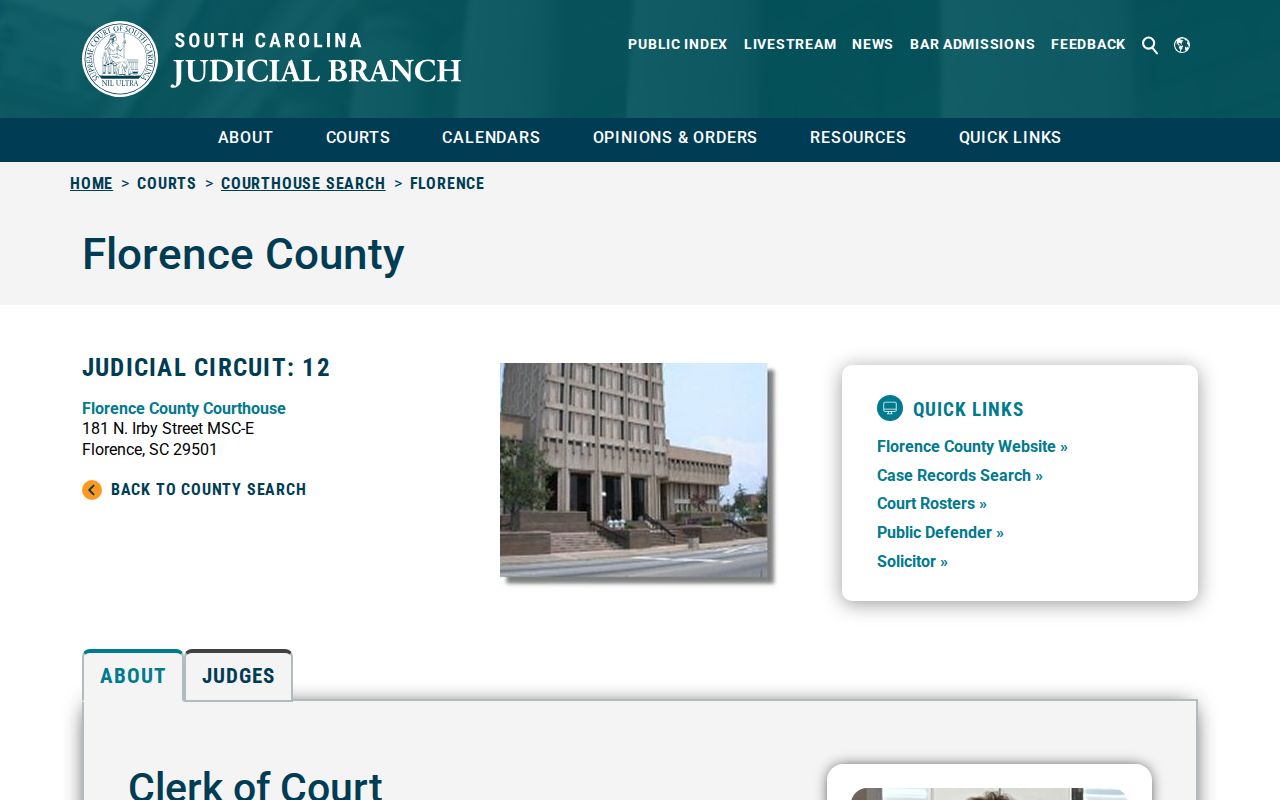
That office is the sound place to ask about General Sessions files that are old, missing online, or not imaged. For summary charges, Florence County has seven magistrate offices, including Florence, Effingham, Lake City, Timmonsville, Johnsonville, Olanta, and Pamplico. Call the court tied to the case rather than assuming every lower-level record sits downtown.
Official Background Checks in South Carolina
The South Carolina Law Enforcement Division, Criminal Justice Information Services, maintains the state Computerized Criminal History and Automated Fingerprint Identification System. Its public product is SLED CATCH. CATCH requires first name, last name, date of birth, and acceptance of its terms; middle name and Social Security number can help narrow a match. Name and birth-date searches use starts-with matching. Multiple likely matches may trigger special processing rather than an instant automated answer.
The official CATCH entry screen displays the terms, account login, and guest route used to order a South Carolina report.
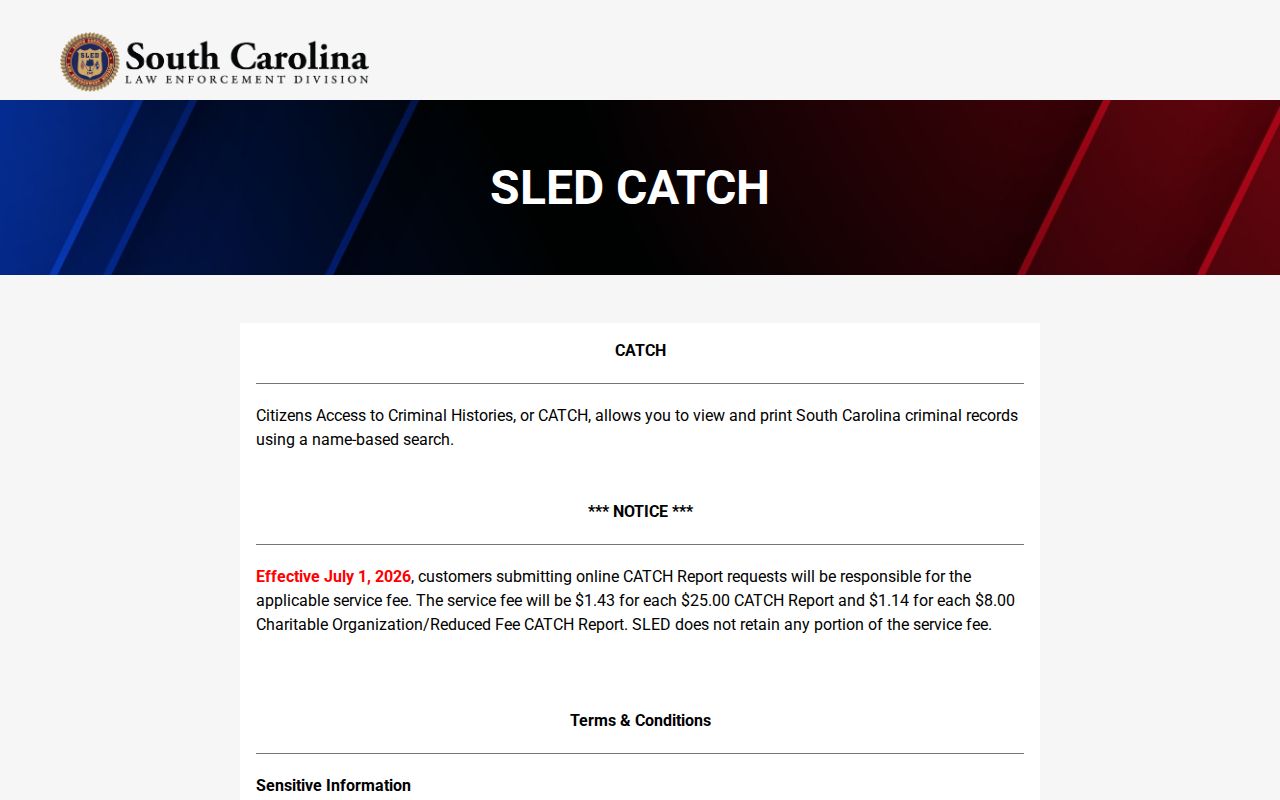
The standard online report costs $25 plus a $1.43 service fee effective July 1, 2026. Qualified reduced reports cost $8 plus $1.14. A mailed request costs $25 and avoids the online service fee, but requires the approved payment instrument and a self-addressed stamped envelope. The public counter has been closed since 2008. A person seeking their own national fingerprint history uses the FBI Identity History Summary route; local law enforcement or IdentoGO may capture fingerprints.
Florence County CATCH Record Gaps
CATCH is statewide, but it is not the same as every Florence County criminal record. SLED explains that the repository depends on fingerprint and disposition submissions. Its July 2026 “Seven Percent” report found that only seven percent of direct indictments in the period studied had reached CCH, chiefly because subjects were not re-fingerprinted. Charge changes also require new fingerprints. A CATCH response that says no record does not prove that no Florence County court file, incident report, booking, or direct indictment exists.
The SLED CJIS overview identifies the repository, fingerprint system, and public dissemination work behind the state result.
When a state report conflicts with a Florence County file, identify the exact arrest and disposition, then contact SLED Public Dissemination and the contributing agency or court. That approach targets the source of the mismatch. Buying the same name report again without resolving the submission issue may reproduce the same gap.
Kinds of Criminal Records
No single Florence County criminal-record product holds the whole event. The arresting agency writes the incident or arrest report. The detention center creates intake and custody data. A magistrate may create bond or initial-appearance records. The prosecutor and court add charges, docket events, pleas, disposition, and sentence. SLED then organizes reported fingerprint-supported cycles in CCH. Each source has a different purpose and access route.
- Agency report: narrative, place, time, officers, and alleged conduct held by its creator.
- Booking record: intake, inmate ID, charge label, agency, and time-sensitive custody status.
- Court file: filed charge, actions, plea, disposition, sentence, and available images.
- Warrant record: judicial authority tracked by a court and law enforcement.
- Repository history: reported South Carolina arrest and disposition cycles linked through fingerprints.
- Supervision or registry record: separate state systems with distinct access and privacy rules.
For state prison custody, use the South Carolina Department of Corrections locator. For probation or parole, use the court file and the state supervision office. SORT is a separate registry and CATCH does not search it. A federal docket or sentence belongs to the federal court, PACER, or Bureau of Prisons layer, not to county or SCDC search tools.
Florence County Warrant Records
The Florence County Sheriff’s Office publishes an active-warrant feed with text search, pagination, and grouped entries. Fields can include warrant number, issue date, physical descriptors, and offense description. The inspected feed did not show the issuing court, bond, service limits, full case status, or a verified update time. Those missing fields matter. A web entry should not be used as the sole basis for trying to resolve a warrant.
The official FCSO warrant search shows the search control and the data available in the public list.
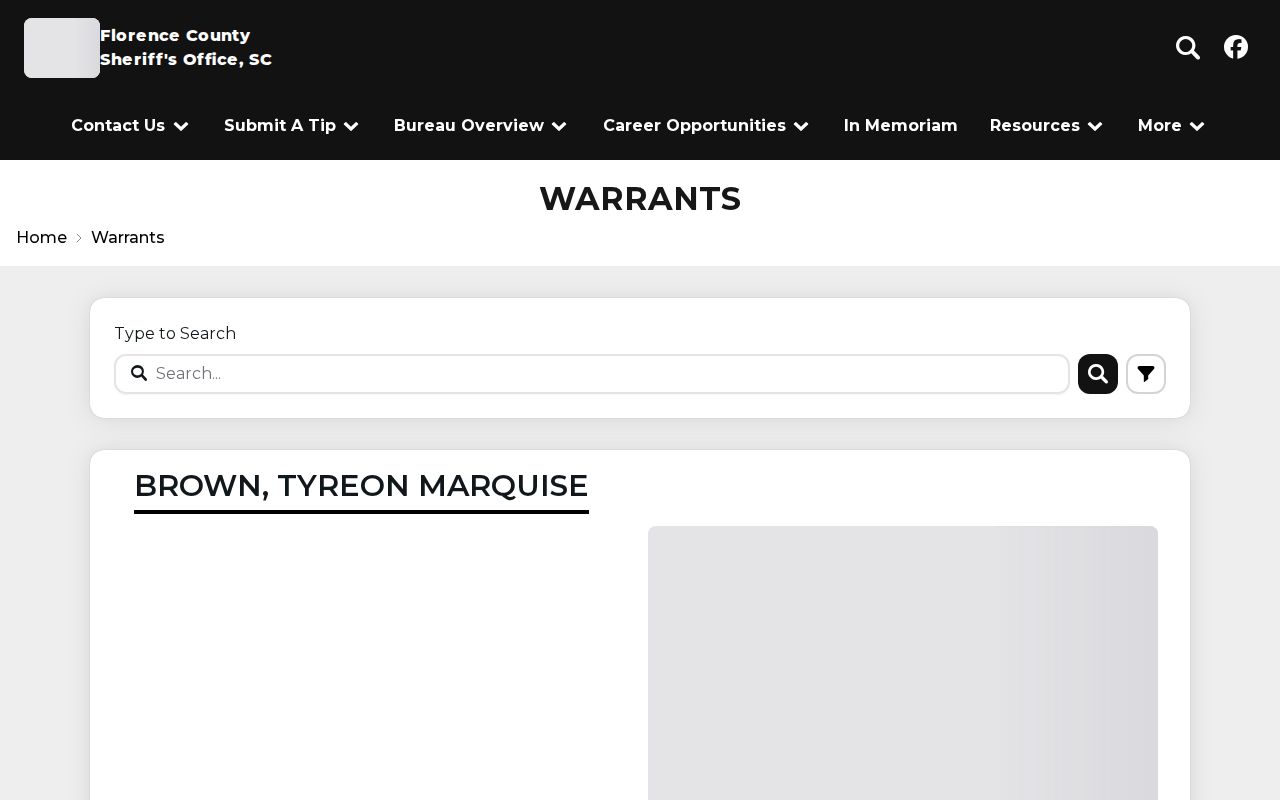
Confirm an entry with FCSO at 843-665-2121 and the likely court. A bench warrant may remain with one of the county magistrates or a municipal court. Public Index may show a related case action, but it is not real-time warrant clearance. NextRequest can be used for nonroutine sheriff-held material, subject to exemptions for active investigations, sealed records, juveniles, victims, witnesses, and security-sensitive facts.
Florence County Criminal Records: What They Contain
Read each Florence County criminal record according to the system that produced it. A booking’s inmate ID is not a Public Index case number, SLED identifier, warrant number, or ticket number. “Pre-Trial” describes an unresolved custody or procedural status, not guilt. “Sentenced” signals sentence-related custody but does not disclose the full judgment. An empty bond or court-date field in the jail view means the field was not displayed, not that no bond or date exists.
| Name & Identifiers | Name, aliases where collected, jail inmate ID, and fingerprint-linked identity data in the repository. |
|---|---|
| Arrest / Booking Data | Booking date and time, custody status, charge description, charge status, arresting agency, and displayed demographics. |
| Charges & Statutes | Allegations at arrest and filed court charges, which can change before disposition. |
| Disposition | Outcome such as dismissal, nolle prosequi, acquittal, plea, or conviction in the court file. |
| Sentence | Court-ordered custody, probation, restitution, or other terms when the public file displays them. |
| Custody / Supervision | County jail, state prison, probation, and parole data live in different official systems. |
A rap sheet is the repository chronology. A disposition is the final result of a charge. Nolle prosequi means the prosecution formally ended that charge. Recognizance is release based on a promise to return, while surety involves a third-party guarantee. Concurrent sentences run together; consecutive sentences run one after another. These terms should be checked against the actual judgment rather than inferred from a brief roster label.
Florence County Sheriff Record Requests
For an FCSO incident report, call the Records Unit at 843-665-2121 extension 80280 before visiting. Staff can confirm whether the report is complete and releasable. The secure NextRequest portal then handles submission, communication with General Counsel, status updates, and electronic delivery. Florence County Administration has a separate FOIA route, but it warns that it is not the custodian for Sheriff’s Office records.
The FCSO public-record instructions direct sheriff requests to the secure portal.
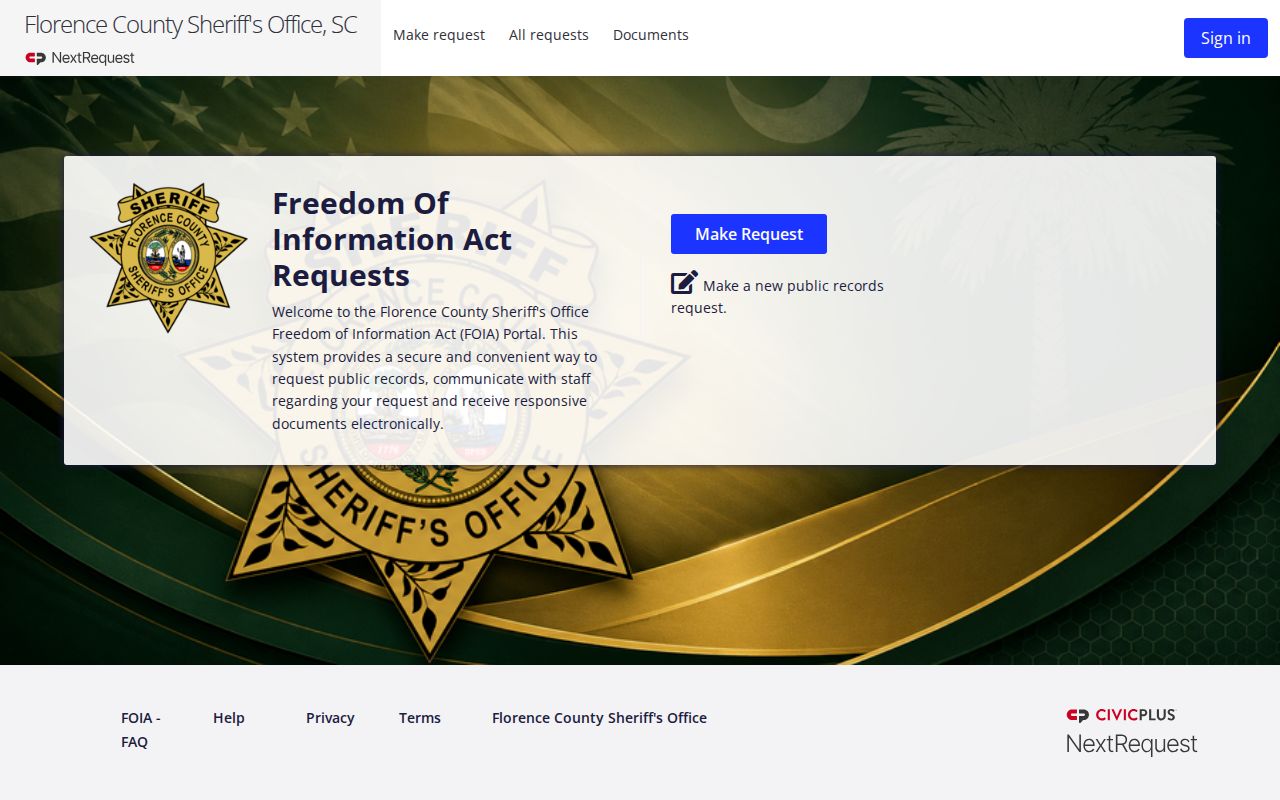
The linked Florence County Sheriff NextRequest service provides the online request and delivery channel.
Describe the record type, approximate date, location, originating agency, and known incident or case number. Fees for report copies were not published. The county’s general rules allow actual search, retrieval, and redaction cost and may require a 25 percent deposit. For newer records, a written determination is due within ten business days and production no later than thirty calendar days after the response; older-record limits are twenty business days and thirty-five calendar days.
South Carolina Public Access Laws
The South Carolina Freedom of Information Act supports inspection, copies, and electronic delivery, but exemptions still protect active investigative material and sensitive personal data. It does not override juvenile confidentiality, expungement, victim protections, or lawful redaction. Florence County criminal history also reflects statutes that govern repository fees, fingerprint reporting, registry fields, and record destruction.
Key Statutes:
S.C. Code §§30-4-10 through 30-4-40 permit public access subject to exemptions and actual-cost fees.
S.C. Code §§23-3-115 and 23-3-120 authorize SLED search fees and establish the fingerprint and criminal-history reporting foundation.
S.C. Code §§17-22-910 through 17-22-950 govern expungement processing and eligible no-cost summary dispositions.
Section 30-2-50 bars knowingly obtaining local-government personal information for commercial solicitation. Registry data has its own lawful-use limits and criminal-misuse penalties. The practical rule is simple: use the clerk for court outcome, the agency or jail for its own report or booking, and SLED for repository or registry information.
Florence County Custody Record Layers
County detention, state prison, and federal custody require separate searches. FCSO’s current feed shows people held at the county detention stage, while its released search covers the preceding three months. SCDC’s locator reports currently sentenced state prisoners as of the prior midnight and excludes released people, county detention, probation, parole, and community supervision. The federal Bureau of Prisons locator is a third system.
The FCSO detention information page describes the county facility’s communication, visitation, and service channels.
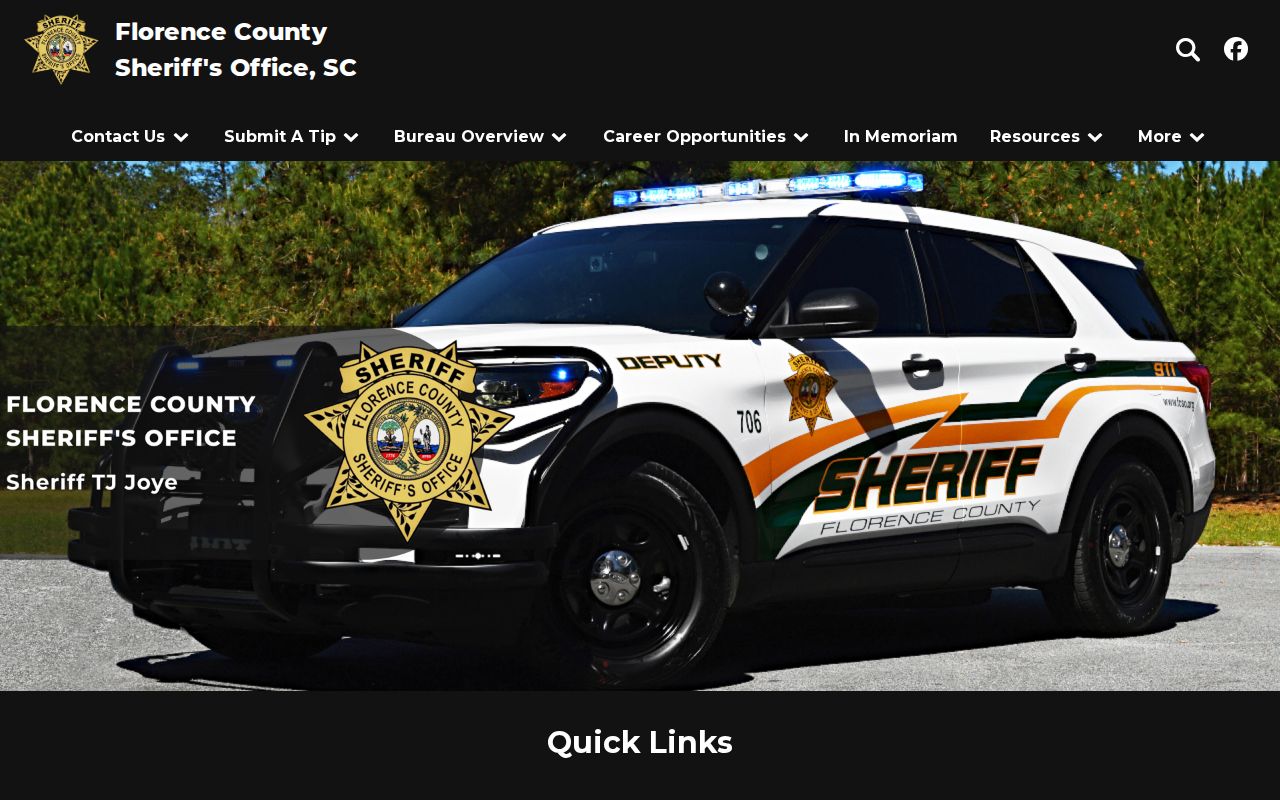
Those services do not substitute for a record request. Detention at 843-665-9944 answers current custody questions, while Sheriff Records handles FCSO reports and older or fuller material. The “Florence County Sheriff’s Office, SC” app for iOS and Android consolidates current and released inmates, warrants, Public Index, registry access, tips, crime maps, FOIA, and alerts. The same official feeds are also available on the FCSO website.
The official Sheriff’s Office home screen brings those Florence County criminal-record services together.
The app adds convenience and alerts, but it is not a separate or more complete record source.
Restricted, Sealed & Expunged Records
Juvenile files, expunged matters, Social Security numbers, account data, victim and minor identifiers, and exempt investigative material can be removed, withheld, or redacted. Under South Carolina law, eligible fingerprinted summary-court charges that end not guilty, dismissed, or nolle prossed generally receive a no-cost automatic order, with exceptions for preliminary-hearing dismissals and linked pending matters. A person who was not fingerprinted may apply to the summary court at no cost.
Other routes include Pretrial Intervention, conditional discharge, a first qualifying magistrate conviction, the Youthful Offender Act, a qualifying first drug conviction, and a first failure to stop. Eligibility turns on the final offense and statute. Typical paid components are $250 for the Solicitor, $25 for SLED verification, and $35 for the clerk, for a $310 total, but exceptions apply. Confirm eligibility and cost with the Twelfth Circuit Solicitor before sending money.
The Florence application goes to the Solicitor at 180 N. Irby Street, Box Q. After the order reaches SLED, allow four weeks. SLED sends no routine confirmation, so a fresh CATCH report can test whether removal occurred. A pardon is a separate remedy and does not erase the record.
Florence County Supervision Records
South Carolina runs probation and parole through the Department of Probation, Parole and Pardon Services. The Florence office is at 181 N. Irby Street, Suite 3100, and its phone is 843-665-3063. A Public Index case may show a probation sentence, violation warrant, revocation motion, or outcome. It may not identify the current officer or display every condition. Detailed supervision records can remain confidential.
The official Florence County supervision-office page identifies the local office and its state-run role.
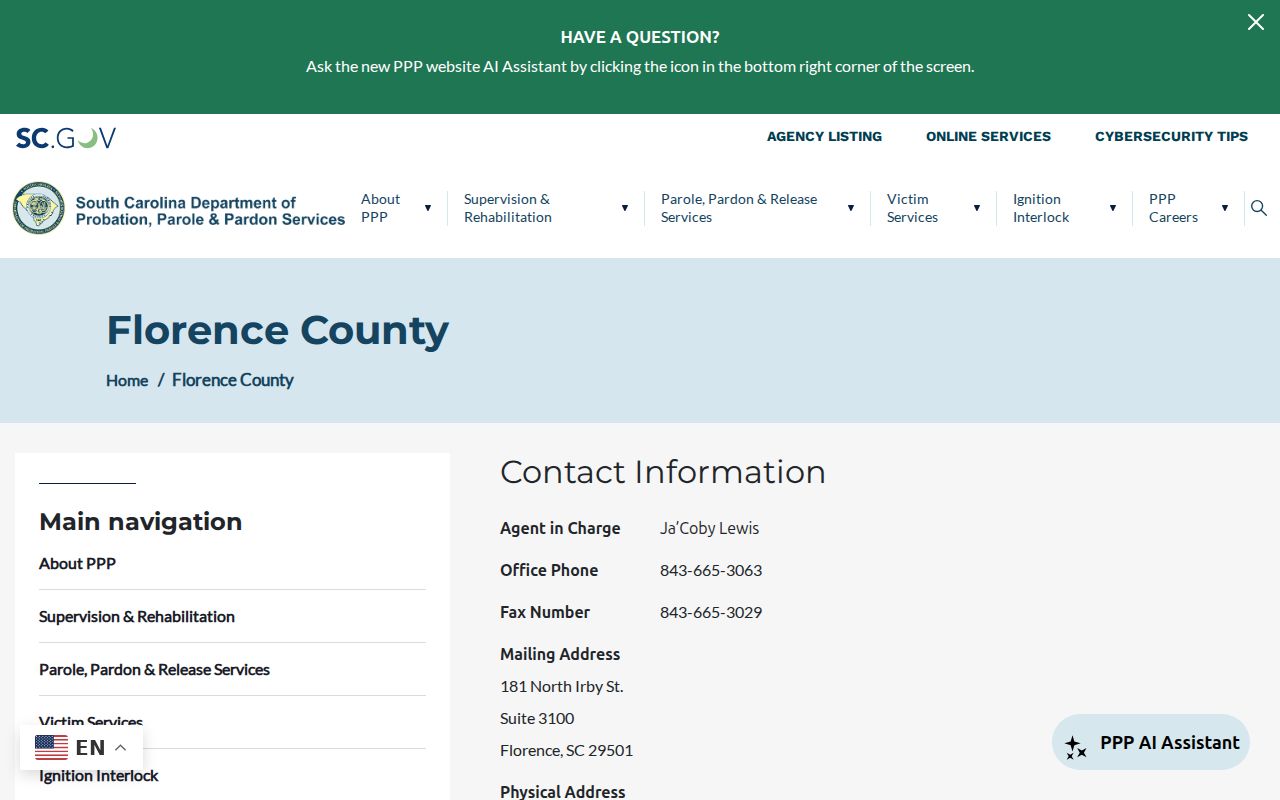
The page’s July 2026 workload counts are a dated snapshot, not a permanent population total. SCDC does not cover community supervision, so disappearance from the prison locator does not prove that supervision ended. Parole hearings occur in Columbia, though registered victims may take part remotely from Florence, online, by phone, in person, or in writing after notice.
Florence County Record Custodians
The arresting-agency field is a routing key. A Florence Police Department report stays with the city even when FCSO books the person. The same rule applies to Lake City Police, Highway Patrol, SCDNR, and other agencies. The jail cannot provide another department’s full narrative simply because it handled intake. FCSO Records is the proper source only when the Sheriff’s Office created the requested report or local arrest-information product.
Clerk of Court
181 N. Irby St., Suite 1100
Florence, SC 29501
843-665-3031
General Sessions case files
FCSO Records Unit
6719 Friendfield Rd.
Effingham, SC 29541
843-665-2121 ext. 80280
Weekdays, 8:30 a.m. to 5 p.m.
Twelfth Circuit Solicitor
180 N. Irby St.
Florence, SC 29501
843-665-3091
Prosecution and expungement
The SCDC Incarcerated Inmate Search is the official record layer for current state-sentenced custody.
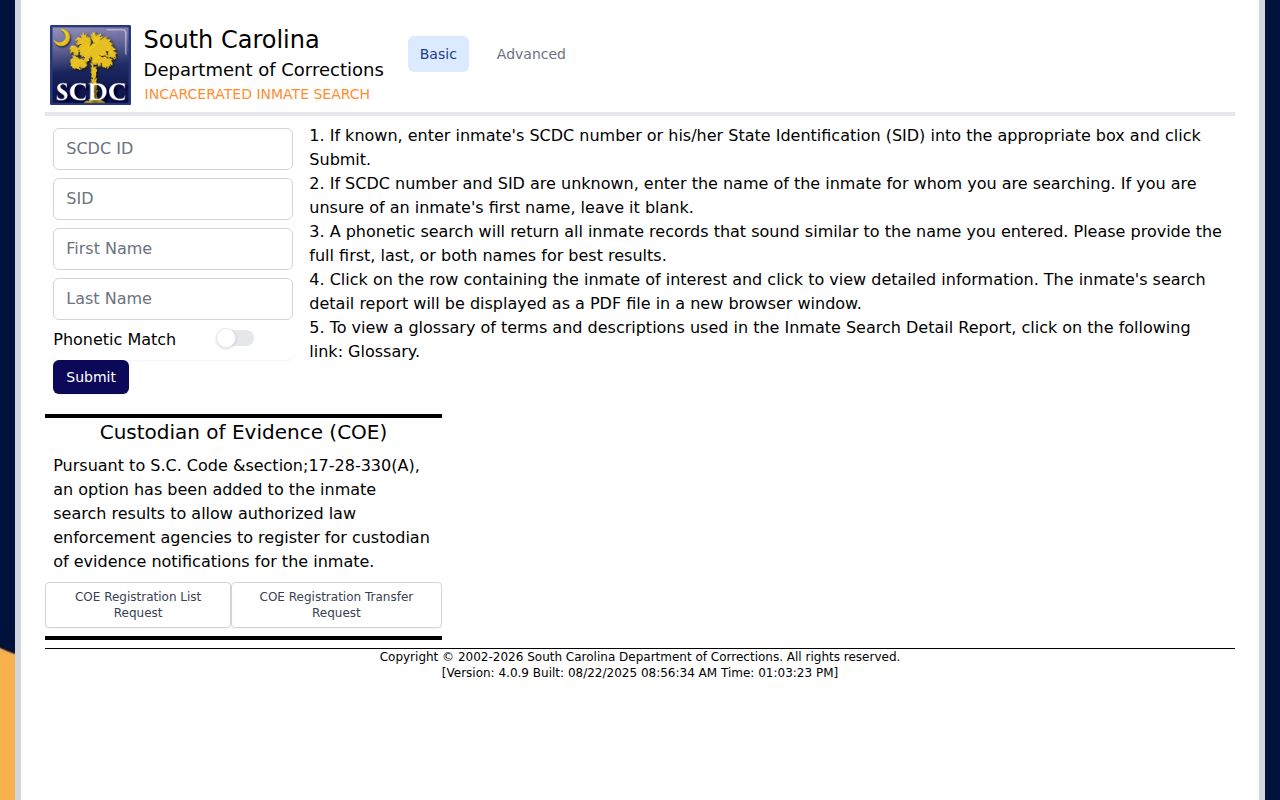
That locator does not replace Florence County detention, court, probation, or parole records.
City-by-City Criminal Records in Florence County
City police departments keep their own reports, and municipal courts keep the matters filed with them. Florence has the county’s largest municipal police and court operation. Lake City relies on a Telephone Response Unit and a municipal clerk, while Timmonsville uses direct town and court contact because no official name-search portal was found. County detention and General Sessions can add later layers without taking ownership of the original city report.
Florence Record Check
Population 41,231 · City police records, Municipal Court, and county booking routes
Lake City Record Check
Population 5,940 · TRU police contact and Municipal Court records
Timmonsville Record Check
Population 2,045 · Town Hall and court phone, fax, and counter channels
Population figures use the official 2025 estimates for Florence and Lake City and the 2020–2024 ACS estimate for Timmonsville. Different Census products are labeled because their dates and methods are not interchangeable.
Florence County Record Context
SLED’s 2023 report counted 75 robberies in Florence County with a 36 percent clearance rate and 37 arsons with a 32 percent clearance rate. Those are event counts, not unique people. SLED warns that arrest counts can include on-view arrests, summonses, citations, and custody events, while several offenses from one event may be counted under its reporting rules. These figures describe a year and method. They do not establish an individual’s conduct or predict a current search result.
Florence began as a railroad junction in 1853, the county formed in 1888, and the city was chartered in 1890. Today, I-95 and I-20 reinforce the county’s transport-hub role. That geography helps explain why city, county, and state agencies may all initiate records. It does not decide custody. The officer’s agency, booking facility, filing court, and final sentence determine which office keeps each part.